Automated Relationship Mapping
Enterprise IT systems built over years consist of layers of network devices, servers, virtualization platforms, databases, and applications, numbering in the hundreds or thousands. Maintaining an asset inventory manually is not only extremely labor-intensive but also becomes outdated the moment it is recorded—servers migrate, VMs are created, applications change deployment locations—making calibration impossible. The Automated Relationship Mapping module uses six types of auto-discovery engines, from network segments to applications, from physical to logical, to continuously and automatically collect and update the existence and relationships of IT resources, keeping CMDB data always consistent with reality.
Why Automation Is Essential
Most enterprises still manage asset inventories in Excel. A few people spend weeks auditing, only for the data to become obsolete within a month of going live. More critically, inventories only record "what exists," not "what depends on what"—if a switch fails, which business is affected? If a VM migrates, will the applications running on it still be recognized? Such relationship information simply cannot be maintained manually.
The core idea of automated relationship mapping: let the system discover, correlate, and update on its own. Six discovery engines each play their role, from low-level network segment scanning to high-level application call relationships, building a complete IT resource relationship network layer by layer.
1. Network Segment Discovery Engine
This is the most fundamental layer. No need to manually tell the system "what network segments exist in the intranet." The engine automatically discovers network segments currently in use and the active IP addresses within each segment. Even "what segments exist" is automatic—far more thorough than traditional tools that require admins to manually configure scan ranges first.
- Automatically identifies network segments in use in the intranet, no manual scan range configuration required
- Within each discovered segment, further identifies currently active IP addresses to clarify "who is online"
- When new segments or newly active IPs are found, automatically triggers subsequent engines for deeper probing, forming an automated "discover-identify-store" pipeline
- Flags disappeared IPs with alerts, prompting admins to confirm whether it is a normal shutdown or abnormal offline
2. Network Device Discovery Engine
Building on network segment discovery, the engine further identifies which IPs are network devices (switches, routers, firewalls, etc.) and collects their model, vendor, port configuration, and runtime status.
- Automatically reads device information via standard management protocols, compatible with mainstream network device vendors
- Collects port status, VLAN configuration, routing tables and other key runtime data, knowing not only "what devices exist" but also "how devices are connected"
- Automatically identifies device roles (core switch, access switch, edge router, etc.), providing input for topology discovery
- Automatically updates CMDB records when device information changes, no manual intervention required
3. Topology Auto-Discovery Engine
Knowing which network devices exist, the next step is to figure out how they are connected. The topology auto-discovery engine, based on device port interconnection information, automatically derives the physical connection topology of the network.
- Uses neighbor discovery protocol information between devices to automatically establish port-level physical connection relationships
- Progressively derives the core-aggregation-access network hierarchy, generating a visual topology
- Automatically updates the topology when the network structure changes (e.g., new switches, rewiring)
- Topology data is the foundation of incident impact analysis—when a link fails, immediately know which devices will be affected
4. Virtualization Auto-Discovery Engine
Modern IT environments heavily use virtualization, with dozens of VMs running on a single physical machine, and VMs migrate dynamically. If only physical machines are discovered and not VMs, CMDB data will be incomplete.
- Connects to mainstream virtualization platforms, automatically obtaining the host-VM mapping
- Collects VM resource configuration, runtime status, cluster membership and other information
- Tracks VM migration events, automatically updating relationships when a VM moves from one host to another
- Incorporates the VM-host hierarchy into CMDB, ensuring both "physical-virtual" resource layers are visible and controllable
5. Application Discovery Engine
The first four layers solve infrastructure discovery. But what enterprises truly care about are business systems, which ultimately manifest as processes and applications running on servers. The application discovery engine, by identifying process information on servers, automatically determines what applications are running.
- Identifies databases, middleware, web services and other application components through OS process information
- Automatically matches against a known application signature library, translating process information into business-understandable application names
- Establishes the vertical association chain of "application — server — VM — host"
- When application deployment location changes, associations update automatically
6. Call Relationship Auto-Discovery Engine
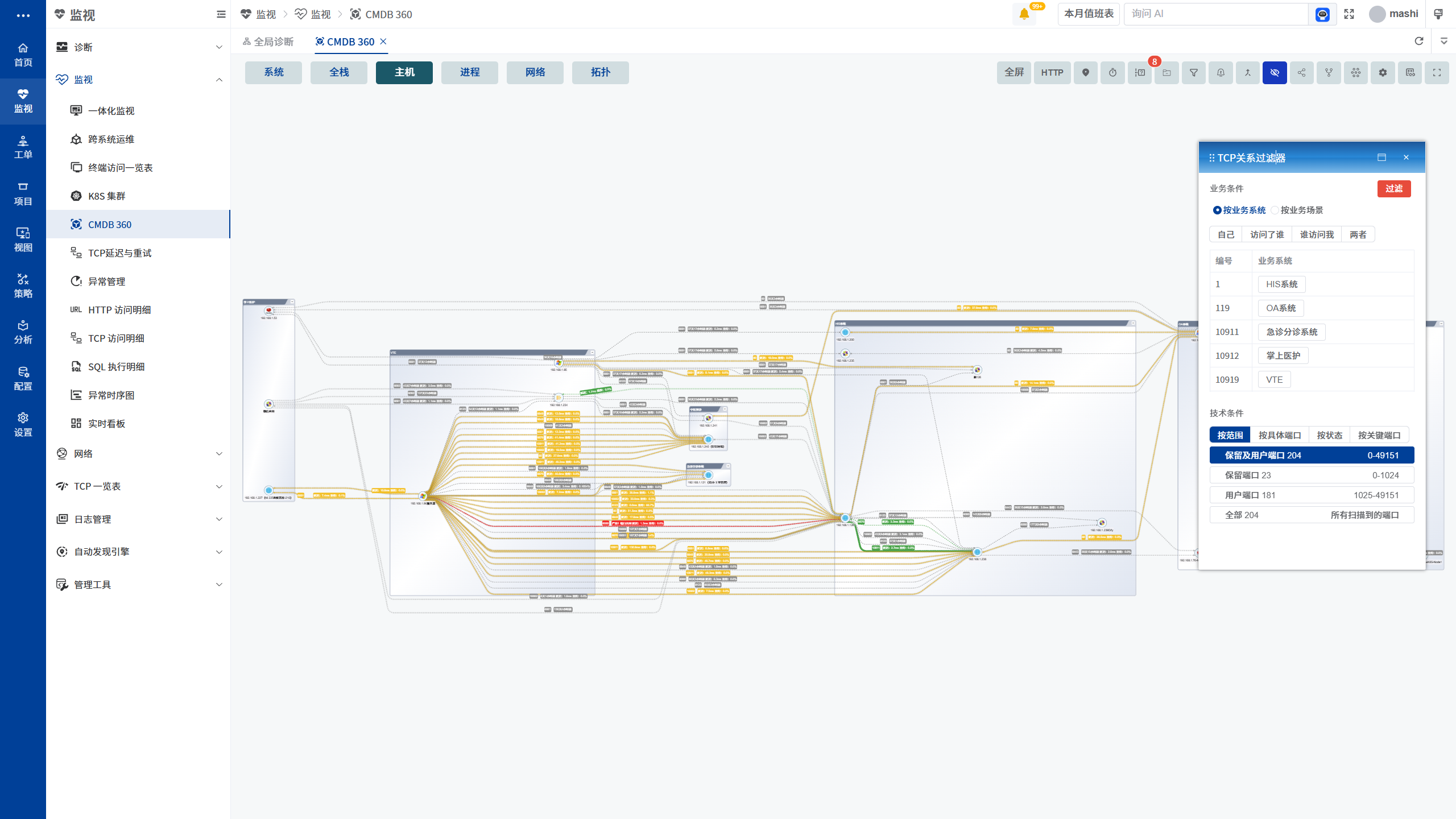
This is the highest and most valuable type of discovery. Knowing where applications are deployed, we also need to know which applications call which — this is the true business logic relationship. The call relationship discovery engine, through network-level connection information, automatically identifies call relationships between applications.
- Analyzes connection information between servers to automatically identify application call chains
- Builds a horizontal logical relationship graph of "App A calls App B, App B depends on Database C"
- When an application fails, quickly locates upstream and downstream affected application systems through call relationships
- Call relationship data provides core support for change impact assessment, incident root cause analysis, and business health analysis
Overall Value of the Six-Layer Discovery
The six discovery engines do not work in isolation but form a complete system that is progressively layered and mutually validated. From "which devices are in the segment" to "how devices are connected" to "what applications run on them" to "how applications call each other," each layer's output feeds the next, ultimately building in the CMDB a panoramic relationship map from physical to logical, from infrastructure to business systems.
- Trusted Data: Automatic discovery replaces manual entry, so data accuracy no longer depends on individual responsibility
- Continuous Calibration: Engines run periodically, data always reflects the latest state, no "outdated inventory" problem
- Traceable Relationships: When incidents occur, quickly locate impact scope and root cause devices along the relationship graph
- Controllable Changes: Before changes, anticipate which business systems are affected, avoiding "changing one config takes down a bunch of apps"